There are books that leave a mark on you even if you don’t realize it at the time.
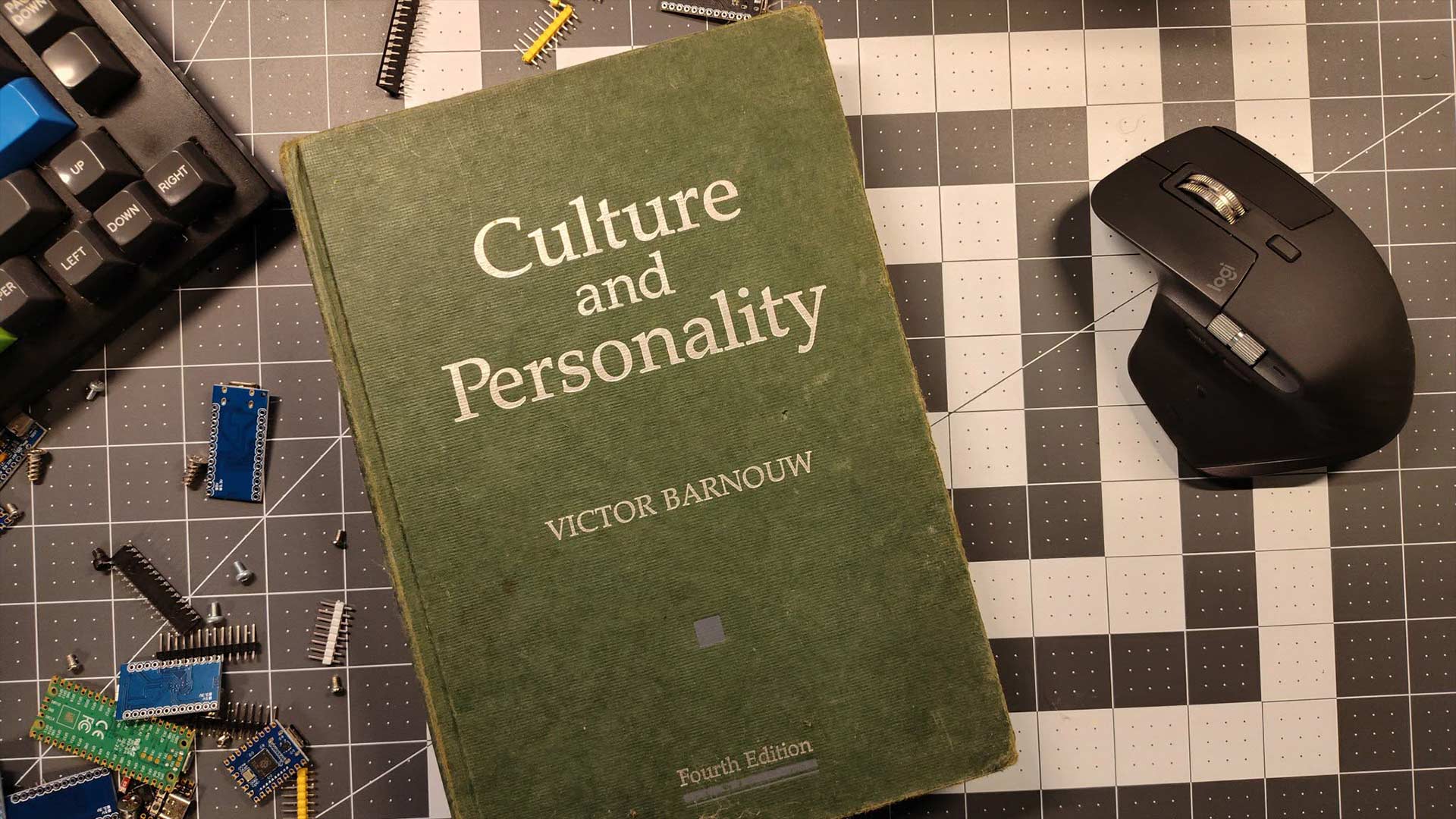
During my first semester at Pace University in 1999, I took ANT108: Introduction to Anthropology. One of our assigned books was Culture and Personality by Victor Barnouw.
I don’t remember what grade I earned in the class, and certainly couldn’t recite chapters from memory, but the title has stayed with me for nearly three decades.
I’ve recently found myself thinking about that book again. I’m not suddenly developing a new interest in anthropology, but I’ve become increasingly uncomfortable with one particular word. Culture.
Somewhere between 1999 and 2026, it feels like the word has become one of the most overused terms in business.
Every company has a culture. Every conference has sessions on culture. Every consultant promises to improve your culture while every LinkedIn post celebrates it. The more I hear the word, the less certain I am that we’re all talking about the same thing.
A Subjectively Objective Take
Anthropologists spend an extraordinary amount of time trying to define culture because it’s one of those concepts that’s easier to recognize than explain.
Culture isn’t a dress code, a slogan, or an employee handbook. It isn’t a mission statement hanging in the lobby, either. It’s the collection of shared behaviors, values, assumptions, traditions, and relationships that emerge among time inside of a group of people.
The important term here is “emerge.” Nobody declares culture into existence like it’s a variable in a programming language. It grows.
Businesses, however, seem to have adopted a very different definition. Company culture has become something to engineer. It’s something that’s packaged and sold.
Some companies confuse mandatory social media participation with culture. Others confuse matching t-shirts with culture. Some think quirky office décor is culture while others insist everyone refer to coworkers as “family.”
These aren’t culture. They’re initiatives, policies, and branding. Calling them culture doesn’t make them culture.
The Take I’ve Adopted
Years ago, I worked for a company whose president had a philosophy that has stayed with me ever since:
- Your coworkers are not your family
- Your family consists of the people you’re related to by blood or marriage
- You don’t choose your family
- You do choose the people you work with
At first, the distinction sounded cold. Over time, I realized it was exactly the opposite. Treating coworkers like adults instead of family created stronger relationships because nobody was pretending the employment agreement was anything other than it was. Trust had to be earned and so did respect. Friendships happened naturally; nothing was forced.
I was a client of the company for years before I became an employee. When I joined the staff, I contributed to a culture that already existed.
Like any organization, we had rough years. We disagreed, we made mistakes, and morale wasn’t always perfect – but the relationships endured. Even after leaving the company, I still exchange emails with leadership, trade messages with members of the service team, and hear from people I worked alongside daily.
Nobody requires that and it isn’t measured. It isn’t included in quarterly objectives, but continues because the relationships are genuine. If that’s not culture, I don’t know what is.
The Other Side of the Fence
I also worked somewhere where they loved talking about family. The term was used in phrases everywhere. It sounded warm, inclusive, and supportive – until it wasn’t.
Over time, many of the people who quietly held the organization together disappeared. I’m not talking about the executives and faces; I’m talking about the people underneath. The ones everyone turned to when things became difficult. Within months, at least from the outside, it looked like the varnish faded because a subculture once existed that did everything posters, messaging, and other “cultural artifacts” couldn’t.
Healthy Skepticism w/ Heartburn
Some of what I’ve experienced has led to me becoming increasingly skeptical whenever I see organizations promising to build culture.
Can culture really be purchased? Can it be outsourced or certified? Can someone “verify” relationships? Is trust something that can be delivered on a quarterly billing cycle?
These questions aren’t meant to mock anyone; they’re genuine.
If culture is an organic property of a community, treating it like a marketing service feels like confusing the symptom for the cause.
Company Culture as Ecosystems
I’ve started thinking about culture the same way I think about ecosystems. You don’t build an ecosystem, you create conditions. Sometimes a healthy forest grows – and sometimes an invasive species takes over. Sometimes mold appears.
Culture works the same way. It’s organic – it responds to the environment around it. The conditions determine what grows. Leadership can influence those conditions. They can create safety, reward honesty, encourage curiosity, and model accountability.
They can also create fear, reward politics, and celebrate appearances over substance.
Either way, culture will emerge. The question is never whether you’ll have one, but if it’s the one you’ve been cultivating is what you really want.
A Pre-W2 Moment of Zen
I found myself returning to a textbook I haven’t opened in decades because back then, culture wasn’t presented as a product. It wasn’t a consulting engagement or a branding exercise; it was simply an attempt to understand why groups of people become who they become. It was a class assignment that became the definition of the term, cemented in my mind, before entering the workforce.
Somewhere along the way, I think we started using the same word to describe office perks, social media participation, and mandatory fun. The foundation never changed – we just poured layer after layer of marketing on top of it until the original definition became difficult to recognize. I don’t think culture can be manufactured. I don’t think it can be mandated or purchased either, at least not with any expectation of sustainability – or being genuine. I think culture is an outcome – and, ironically, something the space I’ve worked in for the past 25 years is obsessed with.
It’s what remains after people spend enough time together to build trust, establish traditions, solve problems, survive difficult moments, and decide the genuine enjoy working toward the same goals. You don’t install it and you don’t discover it. If you have to keep telling people how great your culture is, there’s a good chance you’re describing the wallpaper instead of the foundation.
Over the past months, I’ve worked with several world-class IT management organizations. I’ve been welcomed into each based on existing relationships, trust, and outcomes - and witnessed healthy company cultures that developed on their own without having to be willed into existence. The involvement outside of what’s written in a SOW is a reminder that I’ll likely want to get back to a full-time, dedicated, position in the future – and hearing about “joining a family” will get the Spidey Senses tinging.
If I’m looking to join another “family,” Olive Garden has a much clearer value proposition.
At least the soup, salad, and breadsticks are included.
Contents
Tags
Recent Posts
-
observation
 9/11: 25 Years Later
-
self-hosting
 Bumping Integrated GPU Memory Limits
-
self-hosting
 Containerized ComfyUI with ROCm 10 on the Minisforum N5 Pro Running TrueNAS
-
observation
 Under Our Own Power
-
infrastructure
 What Does “Zero Trust” Actually Mean?
-
What Happens When a CVE Becomes a KEV?
-
The Language We Inherit From Machines
-
DNS Decisions: Recursive, Authoritative, and Forwarding Explained
-
The Real Watermark is You
-
I Like My Web Servers Basic AF