I remember the day I saw a network repeater for the first time - it was mounted in an abandoned elevator shaft.
The building had been renovated years earlier, the elevator removed, and the shaft converted into a vertical chase for running cable between floors. The organization I worked for was expanding, and we’d acquired additional office space twelve floors below the one we already occupied. I called in a structured cabling company to extend the network and spent the day watching them work.
They’re the reason I learned to program a handful of PBXs. They gave me my first fox and hound, and why punching down a 66 block feels as natural to me as terminating a patch panel. While they were hired to solve a problem, they always let me participate in the process. That’s why the memory of a small black box with a few blinking lights hanging in the middle of an empty elevator shaft remains surprisingly vivid more than twenty-five years later.
At the time, I already knew about the physical limitations of CAT5 cabling. I knew signals degraded over distance and that there were practical limits to how far you could push a run before things became unreliable. What I hadn’t seen before was the solution.
The distance between floors wasn’t anywhere near the 100-meter limit. Still, once you accounted for the routing path, service loops, securing the cable, and all the little realities that make real-world installations different from diagrams, someone decided it was worth playing it safe.
“Better safe than sorry, kid.”
The cables were dropped, the repeater was installed, and the connection came online with no problems.
Several years later, we expanded again, this time eight floors in the opposite direction. I worked alongside many of the same technicians who had taught me so much during that first project. We ran dual CAT6 drops to every workspace and didn’t install a single repeater.
Was the original repeater ever really necessary? Probably not. If anything, it introduced an operational risk. It was another powered device that could fail and sever connectivity between two parts of the organization. In hindsight, it was likely solving an issue that didn’t actually exist.
I’m glad it performed flawlessly - or at the very least, remained powered on.
The engineers behind TAT-1 didn’t have the luxury of solving imaginary issues. They were fighting physics and they were doing it on a global scale.
Before TAT-1
When we talk about “the cloud,” we tend to look upward. In reality, we should probably be looking down. Much of the world’s communications infrastructure ultimately depends on cables laid across the ocean floor. That’s true today, and it was true long before the Internet existed.
The first attempts to connect North America and Europe by cable began in the 1850s. The challenge was enormous. Engineers were trying to transmit electrical signals across thousands of miles of ocean using copper conductors wrapped in gutta-percha, a natural latex insulation still used in some dental procedures today.
There were no repeaters, no amplification, and no digital signaling. There were only electrical pulses representing Morse code and the hope that enough of the signal would survive the journey to be understood on the other side. The famous 1858 transatlantic cable worked briefly before failing.
Like many IT failures, it wasn’t one thing. Manufacturing issues, handling problems, and operational mistakes all contributed. The most infamous decision came when chief electrician Wildman Whitehouse attempted to overcome signal loss by applying increasingly high voltages to the cable.
His colleague, Lord Kelvin, warned against it, and Whitehouse ignored him.
The result was roughly equivalent to solving a networking issue by turning every knob to maximum and hoping for the best. The excessive voltage damaged the cable’s insulation, causing current to leak into the surrounding seawater. The cable failed, and the lesson was simple; you can’t bully physics into cooperating. Sooner or later, physics wins.
TAT-1: Repeaters Got Cement Shoes
The repeater sitting in that elevator shaft wasn’t particularly remarkable. It lived in a controlled environment and protected from weather. If it failed, somebody could grab a ladder, swap it out, and have the network restored before lunch. The engineers behind TAT-1 didn’t have that option.
By the time TAT-1 entered service in 1956, engineers had spent nearly a century learning painful lessons about transmitting signals across oceans. The fundamental problem wasn’t complicated. Signals weaken as they travel.
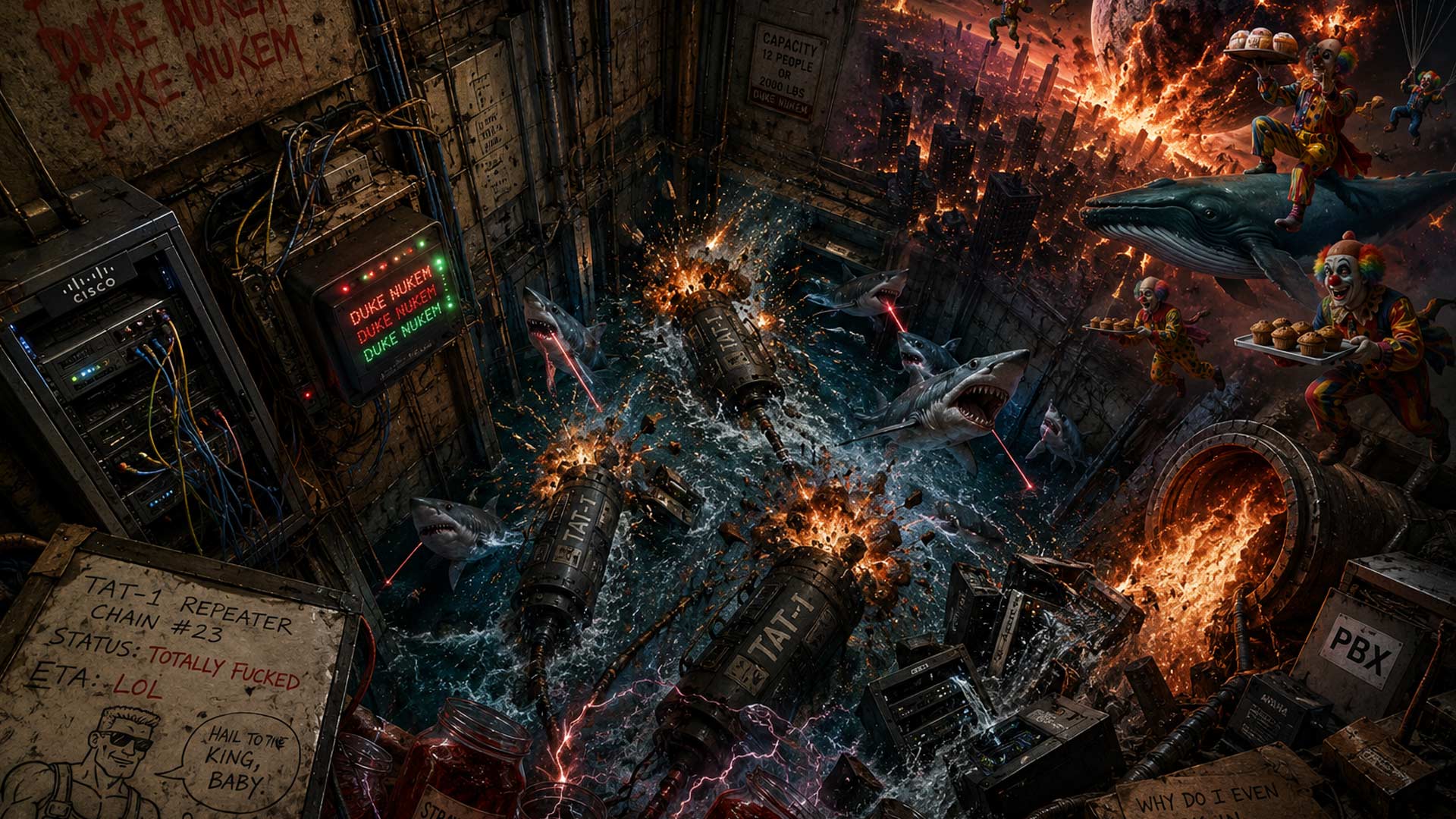
Crossing a few extra floors in an office building is one thing. Crossing the Atlantic Ocean is another. The solution was a chain of 51 repeaters placed along the ocean floor between North America and Europe. Roughly every 70 nautical miles, a repeater would receive an increasingly weak voice signal, amplify it, and send it onward to the next repeater in line.
Conceptually, it wasn’t much different than the device hidden in that elevator shaft. Physically, it was an entirely different challenge.
Each repeater contained vacuum tube amplifiers housed inside pressure-resistant steel cylinders designed to survive the harsh environment of the deep ocean. Once installed, they disappeared beneath thousands of feet of water where access was effectively impossible. There were no maintenance windows, no firmware updates, and no remote hands contract. The expectation was simple. They had to work - not for months or years, but decades.
The engineering challenge wasn’t merely building a repeater. It was building a repeater capable of surviving crushing pressure, corrosion, electrical stress, and complete isolation while operating continuously at the bottom of the Atlantic Ocean. Today, we joke about five nines of uptime while engineers behind TAT-1 were designing equipment that would need to achieve something remarkably close to it without ever being touched again.
The cable itself was an incredible engineering accomplishment, but the repeaters were the real act of faith. Each one represented a sealed black box sitting alone in darkness, trusted to perform its job year after year because there was no practical alternative - a far cry from, “eh, just throw a coupler between the cables, and we’ll figure it out after lunch.”
Same Problem, Better Physics
Modern submarine cable systems solve the same problem TAT-1 faced. The technology is different, but the challenge isn’t.
Instead of electrical voice signals traveling through coaxial cable, today’s systems transmit light through fiber optics. Instead of vacuum tube amplifiers, modern repeaters use Erbium-Doped Fiber Amplifiers (EDFAs), pump lasers, hardened pressure-resistant housings, and power delivered through the cable itself. The components changed, and physics remained constant - as they tend to be.
A signal leaves one shore strong. Thousands of miles later, it arrives weak, something in the middle boosts it, and the signal continues. Every video call, cloud backup, software update, AI-generated image, streaming movie, and online purchase that crosses an ocean still depends on that same basic principle.
Modern repeaters are descendants of the devices deployed with TAT-1 seventy years ago.
They’re solving the same problem as the black box hanging in an abandoned elevator shaft - the only real difference is scale. One helped a network reach another floor while the other helped a conversation reach another continent.
The Internet’s Vertebrae
Today, more than 95 percent of international Internet traffic travels through undersea cables. Not satellites or wireless networks - cables.
Modern systems can carry hundreds of terabits per second across oceans using fiber pairs connected by repeaters spaced every few dozen miles. Landing stations connect continents, specialized ships deploy and repair cables, and routing protocols redirect traffic when something breaks. Despite all that sophistication, submarine cables remain surprisingly fragile. Fishing trawlers drag anchors and ships drop equipment where they shouldn’t. Undersea landslides occur; geology does what geology does.
When failures happen, repair operations can cost tens of thousands of dollars per day and take weeks to complete, depending on location and depth. Redundancy is far from optional here - it’s a matter of survival. Multiple cable routes, geographic diversity, and intelligent routing ensure that when one path disappears, traffic finds another. That’s a lot of engineering effort dedicated to keeping a signal alive - which brings us back to repeaters.
Without them, oceans would remain barriers. With them, oceans become network segments. Cloud computing becomes global instead of regional. International communications become routine, and entire economies become interconnected.
The repeaters sitting on the ocean floor today rarely receive attention. Nobody posts photos of them on social media or coffee mugs - but they’re always there doing the same job that the little black box in the elevator shaft did years ago.
They take a signal that’s beginning to fade, make it strong again, and they keep the conversation going.
Contents
Tags
Recent Posts
-
observation
 9/11: 25 Years Later
-
self-hosting
 Bumping Integrated GPU Memory Limits
-
self-hosting
 Containerized ComfyUI with ROCm 10 on the Minisforum N5 Pro Running TrueNAS
-
observation
 Under Our Own Power
-
infrastructure
 What Does “Zero Trust” Actually Mean?
-
What Happens When a CVE Becomes a KEV?
-
The Language We Inherit From Machines
-
DNS Decisions: Recursive, Authoritative, and Forwarding Explained
-
The Real Watermark is You
-
I Like My Web Servers Basic AF